
Practical Ways to Reduce PM2.5 Exposure
Keep the activities you enjoy. Make the air you breathe cleaner. Open a guide below.
Keeping Haze Out of Your HomeStart with the gaps around your windows and doors.
Reduce the gaps that let haze creep in.
- Close and latch windows and balcony doors. Check the edges, worn seals and sliding-door joints for visible gaps.
- Reduce leaks with weatherstripping or removable sealing tape. Test tape first and keep windows and doors easy to open.
- Close off unused, leakier rooms. A rolled dry towel or draught stopper can reduce a gap under an internal door. It blocks some airflow; it is not a PM2.5 filter.
What sealing can—and cannot—do
It can help
- Slow haze entering through gaps around windows and doors.
- Keep a cleaner room separate from leakier parts of the home.
- Help a purifier work more effectively, if you have one, by reducing incoming pollution.
It cannot
- Remove particles already indoors. Without filtration, they may linger.
- Stop indoor pollution. Cooking, candles, incense and smoking can still add particles.
- Replace fresh air or guarantee a safe PM2.5 level. CO₂, heat and humidity can build up in a closed space.
The aim is fewer avoidable leaks—not an airtight room. Keep essential ventilation, gas-appliance vents and emergency exits clear.
How much it helps depends on the building, wind and indoor activities. Without measurements, you cannot assume a particular percentage reduction.
CO₂: a quick guide
Aim below about 1,000 ppm; consistently above 1,500 ppm means ventilation needs improving. These are ventilation guideposts, not poisoning thresholds.
Rising CO₂ usually signals too little fresh air. At much higher concentrations, CO₂ itself can cause headaches, dizziness and confusion; severe exposure can cause loss of consciousness. Symptoms are not a reliable CO₂ test.
Purifiers do not remove CO₂. If anyone becomes confused, faints or has difficulty breathing, move to fresh air and seek urgent medical help—do not assume CO₂ is the cause.
When to air the room
Check NEA’s regional 1-hour PM2.5 readings. Use cleaner outdoor periods to ventilate; close up again if haze returns. There is no universal “once a day” rule or fixed number of minutes. Do not crowd everyone into a tiny closed room.
Sources: EPA: indoor smoke · HSE: ventilation levels · HSE: high-concentration CO₂ hazards
Choosing a Mask for PM2.5Check the certification, the seller and the seal—not just “95%”.
Country of the standard ≠ country of manufacture. The parenthetical notes explain the difference. A country name or “Made in…” claim does not establish approval.
| Mask or label claimChildren’s-model note below each | Standard / approval region | PM2.5: what the label tells you |
|---|---|---|
| N95 respiratorNIOSH approval · 42 CFR Part 84 Children: no NIOSH-approved children’s version.NIOSH does not approve respirators for children. An adult-approved model marketed as “kids N95” is not thereby approved for children. | United States(US approval; can be manufactured outside the US.) | ≥95%In its standard particle-filtration test. Verify the exact NIOSH-approved model—not just an “N95” label. |
| FFP2 respiratorEN 149 · relevant conformity documentation Children: small sizes are not proof of child-specific approval.“Kids FFP2” or CE marking alone does not establish that the model has been assessed for children. Check its intended users and supporting documents. | Europe(European standard; can be manufactured outside Europe.) | ≥94%In its standard particle-filtration test. For EU-market products, check the Declaration of Conformity and certification details. |
| KN95 respiratorGB 2626 Children: no child-specific approval established by “KN95”.Small sizes are sold, but the KN95 claim alone does not establish suitability for children. See the separate GB/T 38880 row below. | China(Chinese standard; the label does not identify the manufacturing country.) | ≥95%In its standard particle-filtration test. Check the manufacturer, exact model and credible evidence of compliance. |
| GB/T 38880-2020China’s children’s-mask standard Children: a dedicated standard for ages 6–14.Separate from KN95. Check the exact product type and test evidence; the standard number is not blanket government approval or proof of suitability for younger children. | China(Chinese children’s-mask standard; check the actual manufacturing country separately.) | Protective type: ≥95% particle filtration. Hygiene type: ≥90% particle filtration. In the standard’s laboratory tests—not guaranteed reductions in PM2.5 inhaled. Check which type is claimed. |
| GB 19083-2023China’s medical protective-mask standard Children: check the exact product’s intended users.A medical-protective label does not itself mean the product is approved for children. | China(Chinese medical standard; check the stated country of manufacture separately.) | Check the stated grade and test report. Do not infer a child-specific protection level from the standard number. |
| KF94 maskKorean MFDS authorisation Children: authorised small models exist.Verify the exact small-size product in MFDS records. This is product authorisation—not a separate “approved for children” category or a guarantee of fit for every child. | South Korea(Korean authorisation; imported masks also require MFDS authorisation. Check the actual origin.) | ≥94%In its standard particle-filtration test. “KF94” and a Korean-looking package alone do not establish MFDS authorisation. |
| Surgical maskMedical-mask standards vary Children: child-size medical masks exist.Medical-mask status does not make them approved PM2.5 respirators. | Various(Check the actual medical standard and manufacturer; there is no single country of origin.) | No fixed PM2.5 protection percentage while worn. The calculator’s 20% reduction is an illustrative assumption allowing for leaks—not a certified rating. |
| “BFE ≥95%”Bacterial filtration efficiency Children: no child approval from this claim.A material test does not establish age suitability. | Various(A test claim, not a country-specific respirator approval.) | No PM2.5 percentage can be inferred from BFE alone. It tests bacteria-containing droplets, typically around 3 µm, rather than the full PM2.5 mixture. |
| “PFE ≥95%”Particle filtration efficiency Children: no child approval from this claim.A material test does not establish age suitability. | Various(A test claim, not a country-specific respirator approval.) | Potentially relevant to PM2.5, depending on the test particles, airflow and method. It does not guarantee 95% less PM2.5 inhaled or establish N95 approval. |
Verification links and source notes
Mask standards and authorities
These bodies have different roles. A standard number or an agency name on packaging does not, by itself, prove product approval.
BFE and PFE are test measurements, not separate types of respirator certification.
These are different test standards, not identical tests. BFE/PFE claims on a surgical mask do not establish a respirator’s face seal or personal haze protection.
Outside the lab, fit changes everything
A filter’s rating is not your personal protection percentage. Air can leak around the nose, cheeks and chin; talking, movement and taking the mask off also reduce protection.
Air goes through the filter.
More particles are caught.
Air slips around the filter.
You breathe in more particles.
What reduction should I enter?
Try a lower and a higher estimate to see how much the result changes.
These are suggested scenarios to compare—not measured protection ranges. Actual protection can fall outside them. A “95% filtration” label does not mean 95% less PM2.5 inhaled.
Illustrative inputs for a respirator worn throughout the walk. A good seal matters; gaps or slipping can mean much less protection.
Compare low-benefit scenarios because fit and leakage are uncertain. This is not a dependable substitute for a well-fitting respirator during haze.
Don’t automatically use the adult scenarios. A “kids” label, small size or filtration claim does not establish protection while worn.
Include a 0% scenario if fit is uncertain. This tests the result without assuming a mask benefit—it doesn’t claim the mask does nothing.
Use one percentage in the calculator, then re-run with the other. Use a lower value if the mask is off for part of the walk. A seal check can reveal gaps, but cannot measure a percentage.
Choosing an Air PurifierClean air delivery matters more than the price tag.
- CADR: Clean Air Delivery Rate is filtered-air output, usually in m³/h or CFM. For haze, look for independently measured smoke or fine-particle CADR.
- Room size: include the whole connected area. A large “coverage” claim may assume very few air changes per hour.
- Filtration: look for HEPA or independently verified particle removal and whole-unit performance.
- Noise: check CADR and noise at the same usable speed. Maximum CADR and quiet-mode noise describe different settings.
- Running costs: compare filter price, availability, replacement frequency and electricity use at your chosen speed.
- Ozone: avoid ozone generators. Check ionising, plasma and similar features for verified low ozone emissions; turn optional features off if uncertain.
How much CADR does your room need?
Example sizing target: 5 equivalent air changes per hour from filtration, with 2.5 m ceilings. This is a planning target, not a guarantee of a safe concentration.
| Room area | Approximate CADR |
|---|---|
| 10 m² | 125 m³/h |
| 20 m² | 250 m³/h |
| 30 m² | 375 m³/h |
| 40 m² | 500 m³/h |
| 50 m² | 625 m³/h |
CADR (m³/h) = room area (m²) × ceiling height (m) × target air changes per hour
Actual results depend on air mixing, outside air entering the room, indoor sources and fan speed. Filtration recirculates air; it does not supply fresh air or remove CO₂.
Compare value, not just the price tag
Hypothetical prices in S$, assuming equally reliable CADR measurements:
| Example | Price / CADR | Upfront cost per 100 m³/h |
|---|---|---|
| Purifier A | S$200 / 300 m³/h | S$67 |
| Purifier B | S$600 / 400 m³/h | S$150 |
A offers more rated clean air per dollar. But B may still suit you if it delivers the needed CADR more quietly or costs less to run. If A’s filters cost S$80/year and B’s S$40/year, three-year purchase + filter costs are S$440 vs S$720, before electricity. Check each unit at the speed you will actually use.
Sources: EPA: choosing an air cleaner EPA: sensor limitations
Make Your Own Air PurifierTwo simple builds, why they work, and how much air they clean.
A fan pulls room air through a particle filter and blows cleaner air back out. You can start with one filter or build a four-filter box.
Basic fan + filter
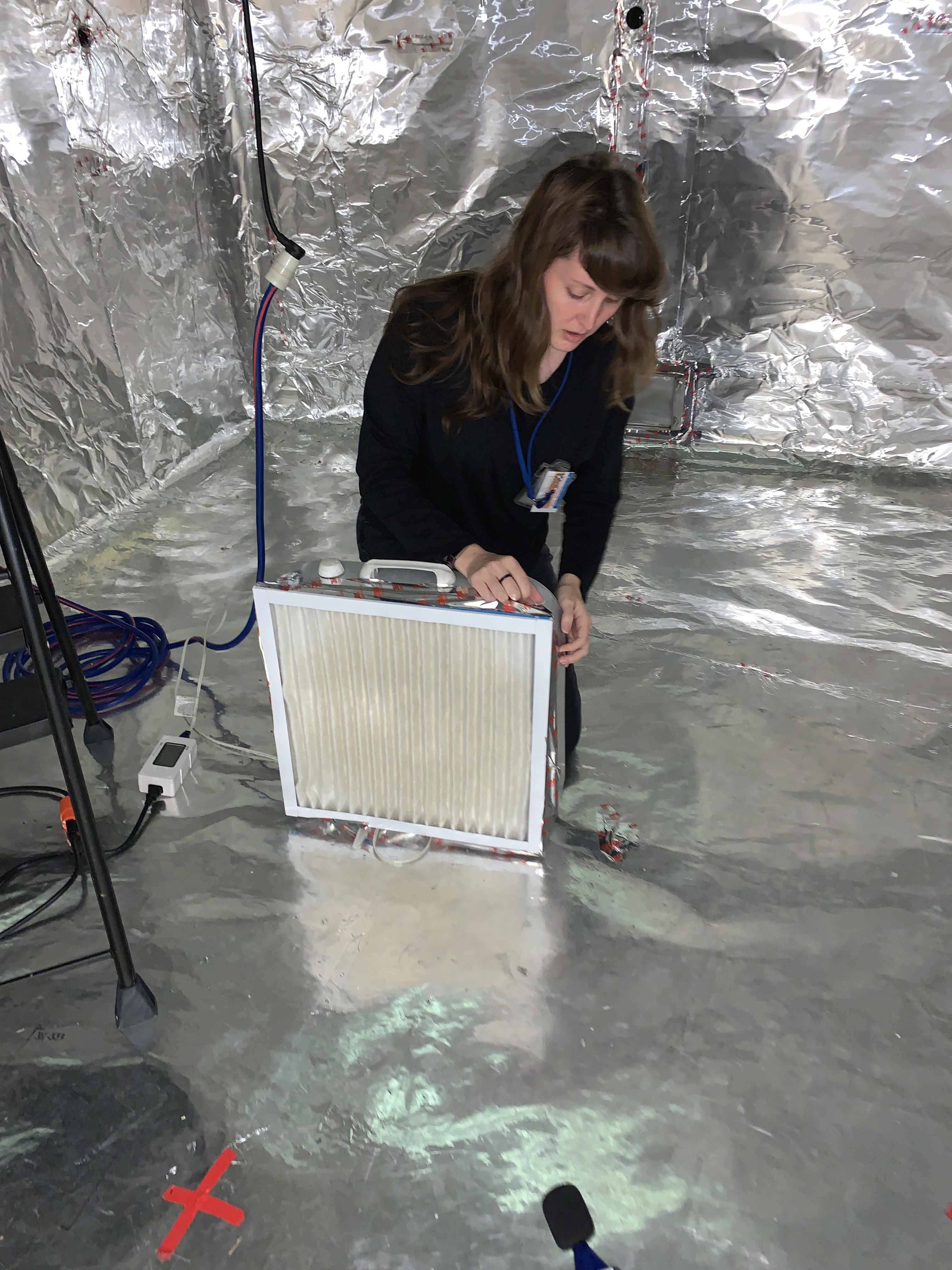
The simplest, cheapest design: one filter on the back of a box fan.
- Unplug the fan. Attach a matching MERV 13 filter to the back, with its airflow arrow pointing toward the fan.
- Tape around the edges so air goes through the filter, not around it.
- Add the cardboard shroud shown below to the front.
Corsi–Rosenthal Box
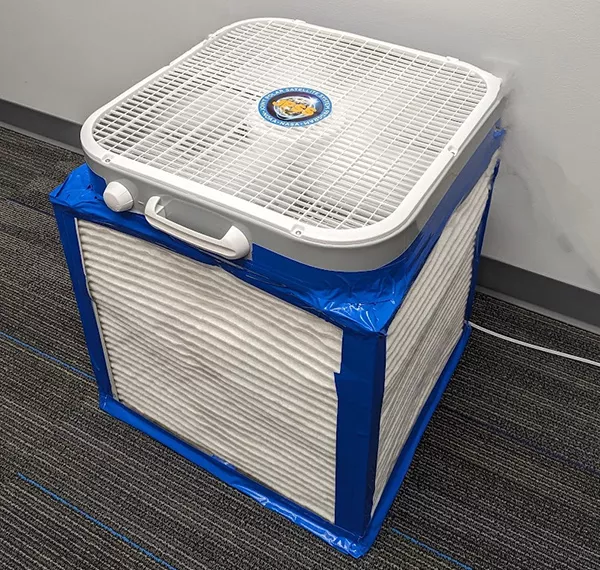
Four filters make the sides; a fan on top blows cleaner air upward.
- Tape four matching MERV 13 filters into a square, with all airflow arrows pointing inward.
- Seal the bottom with cardboard. Secure the fan on top, blowing upward.
- Seal the joints and add a cardboard shroud to the fan’s front.
What could a DIY purifier do?
Explore fan airflow and filter designs. CADR figures below are a simplified what-if illustration, not a performance prediction.
Starting example: compact household standing fan, 1,200 m³/h before filters. Based on the Mi Smart Standing Fan 2’s published maximum of 20 m³/min. Change the slider to match your own fan and speed. This is not a measured DIY-purifier rating.
Use the airflow figure from your fan’s specifications at the chosen speed. This is not watts, RPM or CADR.
Find your fan’s airflowCompare seven examples of household and computer fans
Examples of published fan ratings before adding filters. These are individual models, not typical ranges for every fan of that type.
| Fan example | Rated airflow |
|---|---|
| Small 12 cm computer fanNoctua NF-A12x25 PWM · maximum | ≈102 m³/h |
| 51 cm / 20-inch box fanLasko Pro Power B20548 · high | ≈3,400 m³/h2,000 CFM |
| 40 cm / 16-inch stand fanKDK P40US · rated air delivery | ≈4,860 m³/h81 m³/min |
| 14 cm computer fanNoctua NF-A14 PWM · maximum | ≈140 m³/h140.2 m³/h |
| Compact household standing fanMi Smart Standing Fan 2 · published maximum · demo starting example | ≈1,200 m³/h20 m³/min |
| Household standing fanMi Smart Standing Fan 2 Lite · product-page maximum | ≈1,800 m³/h30 m³/min |
| 30 cm / 12-inch desk fanKDK A30AS · rated air volume | ≈2,520 m³/h42 m³/min |
Look for airflow or air delivery in your fan’s manual. Multiply m³/min by 60, or CFM by about 1.7, to get m³/h.
These ratings can use different test methods. A higher unfiltered number does not guarantee better performance through a filter. These examples are for scale, not recommendations to attach filters to every fan type.
Manufacturer specifications: Noctua · Lasko · KDK Singapore
Additional manufacturer sources: Noctua 14 cm · Mi Standing Fan 2 · Mi Fan 2 Lite · KDK desk fan
A round standing fan is harder to seal to a rectangular filter than a box fan. Air bypassing the filter will not be cleaned. The slider illustrates the idea; these ratings do not establish that a filter attachment is suitable for a particular fan.
This is a rough estimate, not a tested result. Actual CADR may be substantially higher or lower depending on the fan, filters and construction. Do not rely on this number alone when choosing a purifier.
Scaled from the EPA thin-filter example without a shroud. This is an illustration, not a measured CADR for your fan.
How is the illustrative CADR calculated?
We multiply the selected EPA example’s CADR by your slider airflow, divided by Fan A’s nominal unfiltered rating of about 3,090 m³/h. Results are rounded to about 10 m³/h.
This proportional relationship is an assumption, not an EPA finding. It does not account for a different fan’s ability to push against filter resistance, filter brands, leaks or changes in speed. Do not use it to choose room coverage or claim a rating for a homemade purifier.
For a thick filter or four-filter box without a shroud, we add a second assumption: we multiply its shrouded reference by 189 ÷ 265 ≈ 0.71. That ratio comes from the thin-filter comparison. Applying it to other builds is a modelling choice, not a tested finding; the real shroud effect could be smaller or larger. All six settings are what-if illustrations, not product performance estimates.
More airflow through the same filters generally means more clean air.
A thin filter is the simplest starting point. A shroud helps reduce air looping around the fan’s edges.
What’s a shroud?
A cover over the unused corners on the front of a box fan, leaving the blade area open. It reduces air looping backward around the edges, helping the fan push more air through the filters.
Two ways to make one


Same purpose: cover the unused corners while keeping the centre open. Unplug before working, keep the safety guard fitted, and secure all tape away from moving blades.
Filters reduce airflow. This illustration assumes CADR scales directly with the fan’s unfiltered rating; real fans and filters do not necessarily behave that way. These examples use MERV 13 filters, not HEPA.
See EPA-tested examples
Fan used in these examples
Rated airflow before filters: approximately 3,090 m³/h (1,820 CFM).
The study used its 51 cm / 20-inch “Fan A”, a three-speed box fan. The four configurations below were tested on high speed (setting 3 of 3).
3,090 m³/h is the fan’s nominal unfiltered rating—not the airflow through the fitted filters or the CADR. Filters add resistance and reduce airflow. The bars below show measured clean-air output for each complete build; they stay fixed when you move the illustration slider.
CADR = the volume of clean air effectively supplied each hour. No tested figure is shown here for a thick filter or four-filter box without a shroud. Source: study methods and Table 2
How does DIY compare with a commercial purifier?
A well-built DIY cleaner can compete on particle removal. A commercial purifier with a verified CADR offers more predictable performance and may be quieter and more compact. Compare the same pollutant’s CADR, noise and running costs—not just price.
MERV 13 and HEPA are different classifications. MERV rates HVAC filters. HEPA has a generally stricter particle-capture requirement, but the whole purifier’s clean-air output also depends on airflow.
- Use a safety-certified box fan (EPA: 2012 or newer, UL/ETL marked) with thermal protection and the correct local voltage. A plug adaptor does not change voltage.
- Unplug before building or changing filters. Keep guards fitted, airflow clear and the unit stable and dry.
- Follow the fan’s instructions; avoid extension cords, supervise children and keep smoke alarms working.
- Check filters daily during heavy smoke; replace dirty or smoke-smelling filters. Stop using a damaged or overheating fan.
Why get a separate air monitoring device?Check the air where you spend time and see whether your purifier is helping.
- Built-in displays are a guide. They can show trends, but readings vary with the sensor, humidity and particle type.
- Placement changes the picture. A reading near the purifier may not represent the other side of the room.
- An independent check helps. A separate PM2.5 monitor lets you compare rooms and see whether pollution falls when your purifier runs.
Examples of separate PM2.5 monitors
Examples only—not recommendations or endorsements of these models. Photos show the kinds of devices available, not proof of their accuracy.


Choose a device that reports PM2.5 in µg/m³, not just a colour or a general “air quality” score. Check independent tests, the update interval and which features require an app.
A simple check
- Keep the monitor in one spot where you spend time, away from the clean-air outlet, cooking and steam.
- Note the reading. Run the purifier and watch whether PM2.5 falls and stays lower, with windows and activities kept similar.
- Try a higher fan setting if needed. Do not create smoke to test it.
Independent check, better placement. A separate monitor lets you measure away from the purifier, where you actually spend time. That can give a more representative room reading. But being separate does not guarantee a better sensor: accuracy still depends on the model, its condition and the environment. Look for independent testing. Falling PM2.5 suggests particle removal; it does not measure CADR or prove the air is safe.
Exercising Outdoors During HazeHeavier breathing means more air inhaled. Choose cleaner times and places.
Exercise makes you breathe more deeply and quickly, increasing the volume of polluted air inhaled at the same PM2.5 concentration.
Solid bars show the lower estimate; striped extensions show the range. Same pollution concentration throughout.
- Choose cleaner times and places; check current readings before heading out.
- Keep away from busy roads and pollution peaks.
- Move strenuous exercise to a cleaner indoor space when outdoor air is poor.
- Take extra care with children and people with asthma, heart or lung conditions; follow individual medical advice.
- Keep moving: the aim is less pollution exposure while preserving the benefits of physical activity.
Background: WHO: activity and pollution EPA: inhalation rates The multipliers above are teaching examples, not WHO activity thresholds.